
The Turkish Bath
- Date of Creation:
- 1862
- Height (cm):
- 108.00
- Length (cm):
- 110.00
- Medium:
- Other
- Support:
- Wood
- Subject:
- Scenery
- Framed:
- Yes
- Art Movement:
- Neoclassicism
- Created by:
- Current Location:
- Paris, France
- Displayed at:
- Musée du Louvre
- Owner:
- Musée du Louvre
The Turkish Bath Story / Theme
-

The Turkish Bath
-
The Turkish Bath
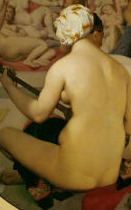
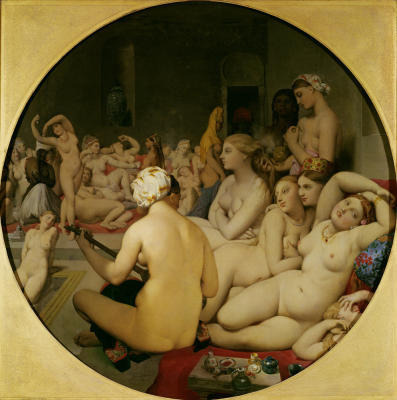
The Turkish Bath is the culmination of all things Ingres considered great throughout his artistic career; female nudes and the Orient. He combined these two themes one last time, borrowing figures from his earlier paintings and from the many figure studies he sketched. It is said that no live models were used for this work.
In this erotic, harem scene Ingres displays a room full of Turkish women who have just returned from the pool, a theme inspired by the letters of Lady Montagu, who visited a women's bathhouse in Istanbul in the early eighteenth century.
An obvious reoccurring character is The Valpinçon Bather who, in her first time as Ingres' model scored the staring role as the only figure on the canvas. In her second appearance she still gains attention by being placed in the foreground, but this time she serenades the many other women with a stringed instrument. The other women lounge on sofas in various poses listening to her. Some dance in the background, others looking into a far off space. Some chat with another or drink coffee. The main element of eroticism in the painting focuses on two women, one of whom is caressing the breast of another sitting next to her.
The Turkish Bath Inspirations for the Work
-
Lady Mary Wortley Montagu
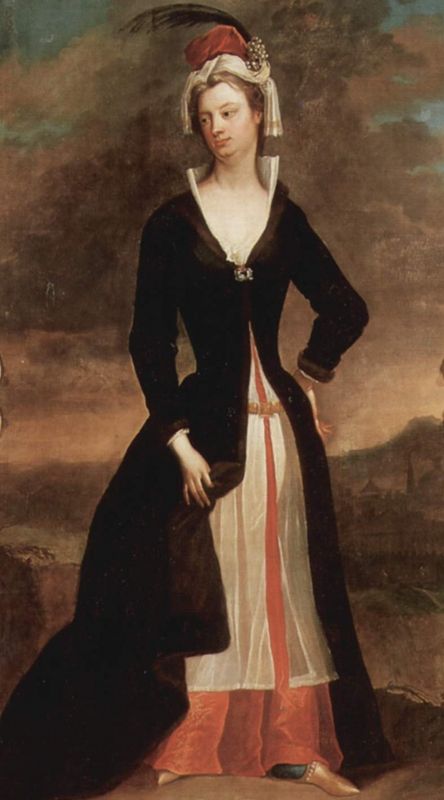
Ingres took a fascination to the customs of the near Eastern world. He was particularly intrigued by the exotic sensuality of the Orient. With the common theme of the female nude, Ingres added his own preference by using females at a bathhouse as his main inspiration for the work. He combines figures used in his previous paintings and his numerous figure studies to form the group. He owes such inspiration to excerpts from Lady Montagu's letter of her travels to a bathhouse.
Exotic letters:
Ingres' liking of the Orient is the driving force behind The Turkish Bath. Ingres' inspiration for The Turkish Bath came from the letters of Lady Mary Wortley Montagu. In her two letters she describes the interior of a bathhouse in Istanbul of the early eighteenth century. It is said that Ingres copied the letters into his own notebook, probably around 1817.
The Turkish Bath Analysis
-
The Turkish Bath
-
The Turkish Bath
-
The Turkish Bath
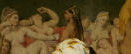
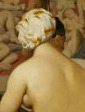
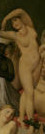
A favorite subject of Ingres was the female nude. He loved to experiment and imaginatively enhance the female form as he considered it ideal. In The Turkish Bath he takes the liberty of showing as many idealized figures as the canvas space will allow.
Composition:
Ingres divides the group of harem bathers into two. They exist in a deep but undefined space that lacks depth. The loungers set in the foreground are drawn in Ingres' particular fancy of anatomical distortion while the women in the background overlap one another making it difficult to judge anatomical correctness.
Use of Color:
Under the classical training of David, Ingres was taught to focus more on drawing than on color. Though he paid meticulous attention to the details of the line, his use of colors is also carefully planned. His subjects are portrayed in a cold, filtered light, which tones down the relief of the figures, allowing line to dominate.
Lighting:
The light falls on the bather with her back turned to the viewer drawing attention to her. He highlights her left shoulder. The women in the foreground are void of such drastic highlights to their skin while the bathers in the background lounge in the shade. Their skin has a grayish tone.
Tone/Mood/Emotions elicited:
As usual, Ingres conjures up an obvious erotic mood as the women lounge in various positions on the plush sofas of the bath house. After having just come from the pool, many of the bathers are quite relaxed. Some woman dance, others chat. They lay on one another, they play with each other's hair. The most sensual portion of the painting is the rightmost part of the foreground where one bather gives a few view of her breasts while the others just behind her touch another.
Brushstroke:
Ingres used tight brushwork to achieve his near photographic realism. He captured the likeness of skin, as well as the textures of the silk and velvet.
The Turkish Bath Critical Reception
-
Pablo Picasso
The Turkish Bath was commissioned by Prince Napoleon. After being sent back for its excessive nudity, The Turkish Bath remained in Ingres' possession while he made the changes necessary to please the Princess Napoleon. He signed it in 1862. It wasn't released to the public until after his death.
Contemporary Reception:
Ingres' The Turkish Bath and paintings with similar misrepresentations of the female body have recently come under attack from feminist scholars. They disregard the claim that such disfigurations were the artist's quest for ideal beauty and instead believe that his reconfiguration of the female form was based upon a sadistic distortion of the female body.
Posthumous Reception:
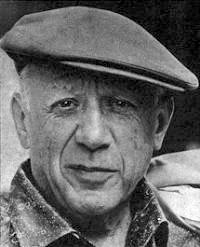
At its greater public exposure in the Salon 1905 reactions were mixed. There were the usual hecklers who didn't understand the imagination of Ingres and critiqued his work harshly. Then there was Picasso. The Turkish Bath caught his attention in a manner that excited him deeply, enough for him to pay homage to this inspired canvas.
Modern Day Reception:
The Turkish Bath is considered a late masterpiece, as it was revealed to the public after Ingres' death.
The Turkish Bath Related Paintings
-
-
-
-
Les Demoiselles d'Avignon
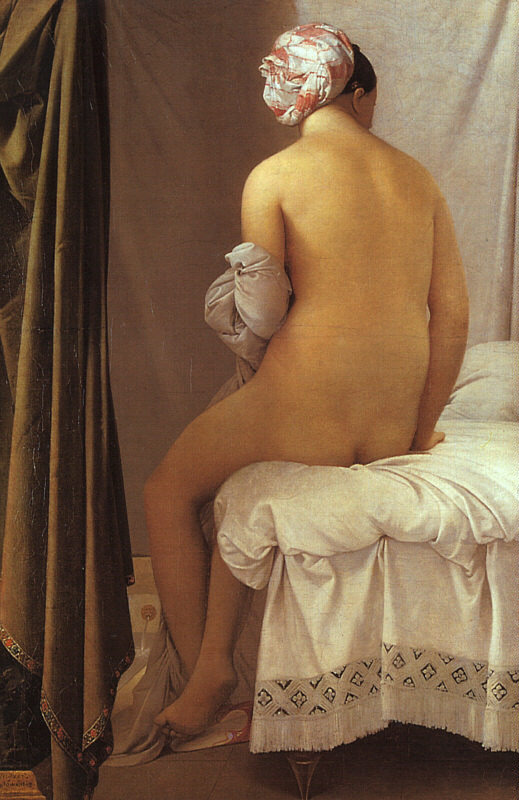
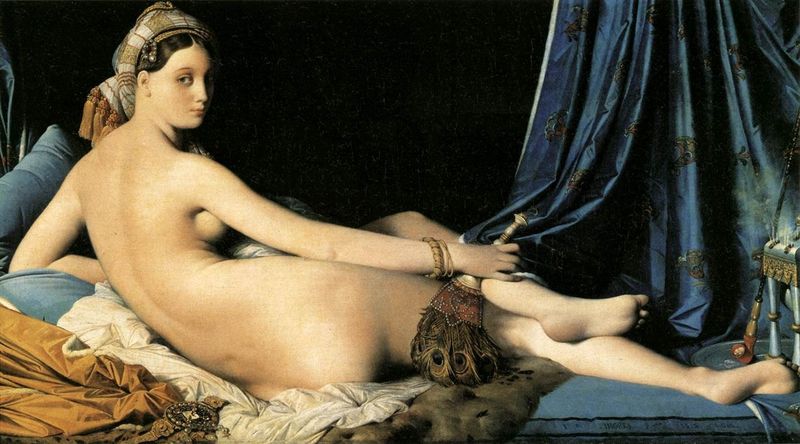
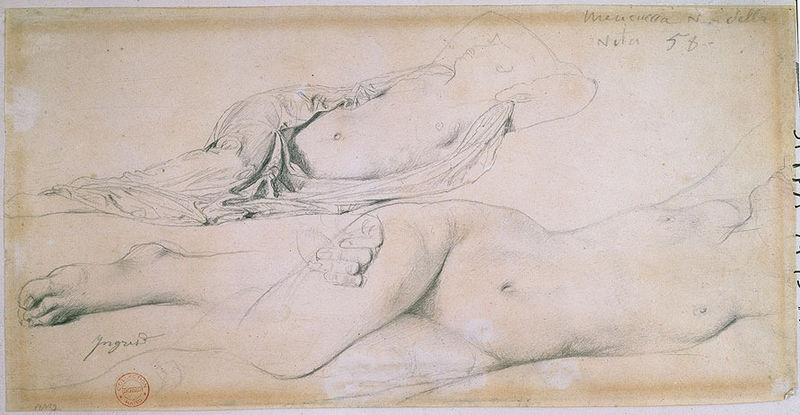
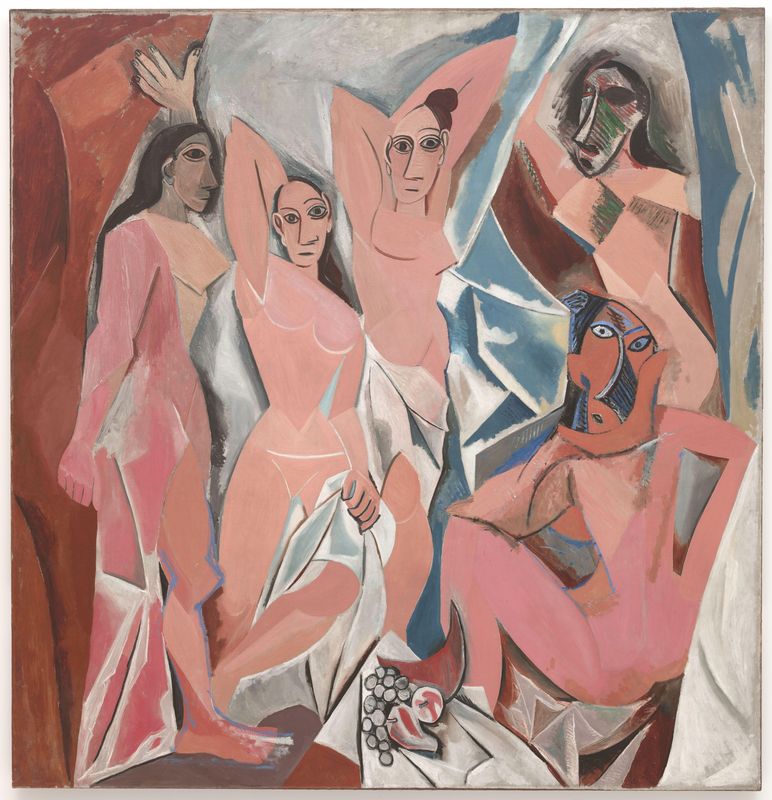
Ingres remained fascinated with the far away Orient throughout his career. Before painting The Turkish Bath, his final masterpiece, he dabbled in this exotic theme in The Valpinçon Bather, and with many of his sketches of the female form. An exceptional example is his Double Study for Odalisque with Slave. His figure studies later proved useful when painting The Turkish Bath. As with most of his work, The Turkish Bath especially influenced the great modern art master, Pablo Picasso.
Works By Ingres:
The Valpinçon Bather, 1808:
One of Ingres' earlier works, The Valpinçon Bather was a direct inspiration for his later The Turkish Bath. The starring figure in his 1808 work can be seen in almost exact simulation in The Turkish Bath. His early interest in eroticism only strengthened as he added more nudes to his late masterpiece. Her second appearance seems a little out of place amongst the rest of the bathers as she is the only one with her back turned to the viewers. The light falling on her puts her in strange focus and sets her apart from the others. She gains attention as her skin is a different tone than her comrades.
La Grande Odalisque, 1814:
One of Ingres' first experiments with themes of the Orient was in La Grande Odalisque. The odalisque, servant to the Sultan's pleasure, displays Ingres' vivid imagination. He applied anatomic distortions to her figure, elongating her back and pelvis area to create a more ideal form. Her position was early preparation for the many positions he would later draw in The Turkish Bath.
Double Study for Odalisque with Slave, circa 1839:
Several of Ingres's sketch drawings attest to his interest in the representation of the female nude and in eroticism. These drawings display his desire to achieve a description of the female body that is both ideal and voluptuous. These studies may have been used later on for The Turkish Bath.
Work by other Artists:
Les Demoiselles d'Avignon, 1907, Picasso:
The influence of Ingres on Picasso can be seen throughout Pablo's career. Like Ingres, Picasso would create a world with a few lines of the pen, adding his colors after his design. One of Picasso's greatest additions to the art world, Cubism, was also influenced by Ingres.
It is ironic to note that as Picasso was praised for Cubism, a resort to primitivism, Ingres was harshly chided by critics for his purposeful return to art's primitive state. The Turkish Bath was revealed to a wider public in 1905, in which Picasso was in attendance. It inspired him greatly. Note the flatness and similar poses between the two works.
The Turkish Bath Locations Through Time - Notable Sales
In 1859, The Turkish Bath was bought by Prince Napoleon. It is known from a photograph dated October 7, 1859 that this painting was originally square. On the insistence of Princess Clotilde that there were too many nudes, the Prince returned it to Ingres. Several years passed in which Ingres made changes and gave it its circular form before he signed it in 1862. It was released to the public after his death. It currently resides in the Louvre.
The Turkish Bath Artist
-
J.A.D. Ingres
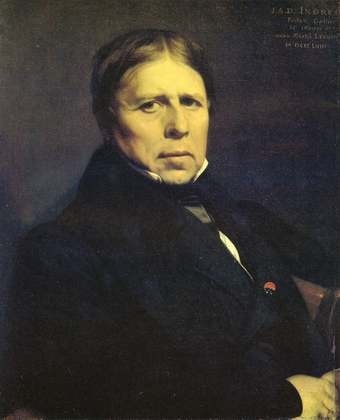
It wasn't until his latter years that Ingres completed his most notable works - female nudes. His two most recognizable pieces are La Source and The Turkish Bath. In the Turkish Bath Ingres displays the female body in many distorted poses and in his famous idealistic fashion. This canvas came under criticism from art fans but this was not new to Ingres, an artist who became used to controversy surrounding his work. Today The Turkish Bath is considered a late masterpiece, as it was only revealed to the public upon Ingres' death.
The Turkish Bath Art Period
Neoclassicism is the 18th century revival of classical beliefs. It differs from other revivals as Neoclassical artists approached the ancient subject with a newer, more scientific approach. They also combined an interest in both ancient worlds; Greece and Rome. The artifacts uncovered at Pompeii and Herculaneum contributed significantly to this rebirth of classicism. Artists like Ingres portrayed the absolute truth of life through the "pure and simple" verities of antiquity. Neoclassicism replaced frivolity and superficiality of the Rococo movement.
The Turkish Bath Bibliography
Find out more about this and Ingres's other works by referring to the recommended reading list below.
• Boime, Albert. Art in an Age of Bonapartism, 1800-1815. Chicago: Chicago University Press, 1993
• Fisher, Jay M. The Essence Of Line: French Drawings From Ingres To Degas. Pennsylvania: Pennsylvania State University Press, July, 2005
• Grimme, Karin H. Jean Auguste Dominique Ingres: Taschen Basic Art. New York: TASCHEN, December, 2006