
The Young Beggar
- Date of Creation:
- circa 1650
- Alternative Names:
- The Louse-Ridden Boy
- Height (cm):
- 134.00
- Length (cm):
- 110.00
- Medium:
- Oil
- Support:
- Canvas
- Subject:
- Figure
- Framed:
- Yes
- Art Movement:
- Baroque
- Created by:
- Current Location:
- Paris, France
- Displayed at:
- Musée du Louvre
- Owner:
- Musée du Louvre
- The Young Beggar Page's Content
- Story / Theme
- Inspirations for the Work
- Analysis
- Related Paintings
- Artist
- Art Period
- Bibliography
The Young Beggar Story / Theme
-

The Young Beggar
-
The Young Beggar
-
The Young Beggar
-
The Young Beggar
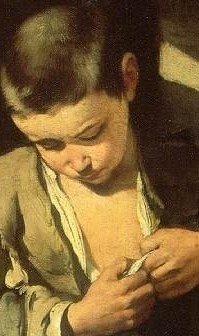
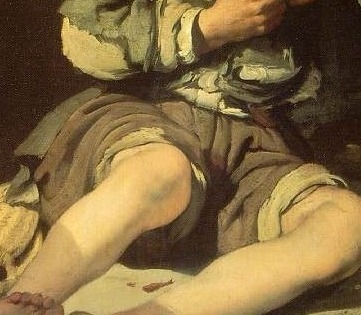
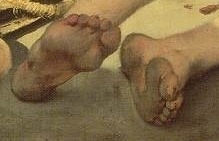
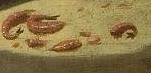
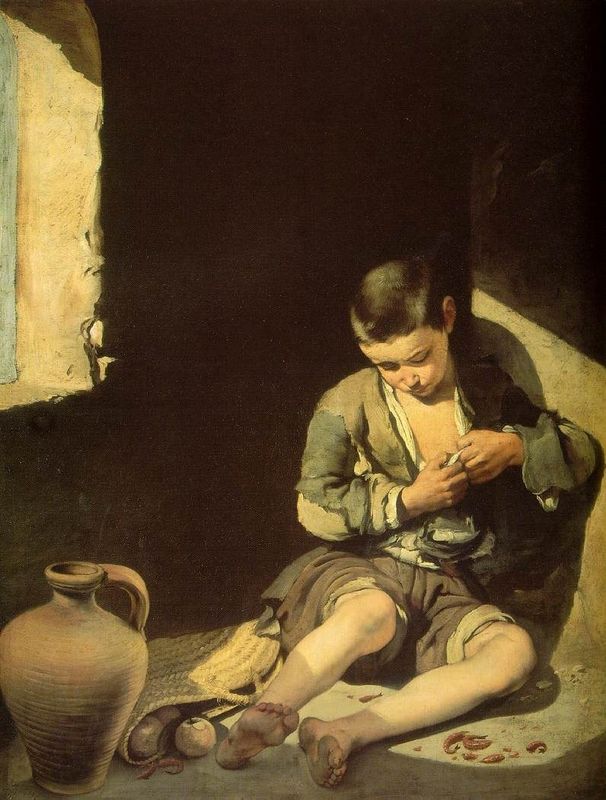
Murillo's The Young Beggar (also known as The Louse-Ridden Boy) is the first known example of the artist's overwhelmingly popular genre paintings featuring the street children of Seville. The Young Beggar depicts a barefoot young street urchin clad in torn, patched-up rags, relaxing after what appears to have been a light lunch of shrimp and apples (common fare for the poor at the time).
The subject of the painting reflects the harsh reality of 17th century Spain, where poverty was rampant and ravaging plagues left many children orphaned and left to fend for themselves on the streets.
The Young Beggar is a kind of pictorial counterpart to the "picaresque" (low-life) figures so common in Spanish literature of the time, such as the classic Lazarillo de Tormes, the tale of one impoverished youth's dishonest and unscrupulous scrabble up the social ladder.
Murillo's idealized depiction of the urchin, however, conveniently ignores the more harrowing aspects of an orphaned child's life on the streets. The little scamp is engrossed in an activity which the contemporary viewer may not immediately grasp: searching for and killing lice.
This may be a seemingly banal or even distasteful subject for a painting, but in fact pictures of delousing abounded in the 16th and 17th centuries. The subject was particularly popular in Dutch genre scenes, which often depicted mothers delousing their children's hair. This hygienic act was seen as symbolic of purity and cleansing oneself of sin, as well as a testament to motherly responsibilities.
The subject of delousing then infiltrated Italy and Spain, and from time to time could take on other connotations: also popular were images of a man and woman searching each other for lice, an act which was interpreted as erotic in nature. In Murillo's case, the boy's act of self-delousing most likely has a spiritual message, referring to the innocence and purity of children.
The Commission:
The circumstances surrounding the commission of Murillo's Young Beggar are unknown. The painter may have been drawn to paint such subjects due to his religious faith: Murillo was a member of the Franciscan Order, which preached living a humble lifestyle and being charitable towards the poor.
It is generally assumed that Flemish merchants living in Seville most likely commissioned this, the first of Murillo's genre scenes; such pictures flourished in both Dutch and Flemish art. Murillo's street urchins would come to be in huge demand later in his career and would be particularly cherished during the 18th century Rococo period.
The Young Beggar Inspirations for the Work
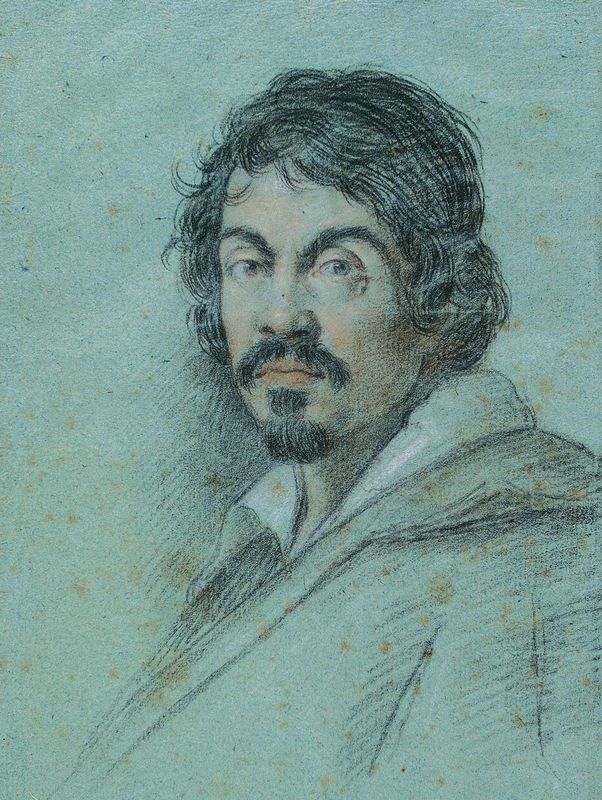
This painting shows the influence of various artists, namely Caravaggio, Velázquez and Zurbarán and uses contrasting light and shade. Murillo also uses thick brushstrokes and impasto. The Young Beggar was surely also inspired by the misery in the streets of Seville during the Golden Age.
Like his predecessors, Murillo focused on intricate details such as the boy's dirtiness, and the still-life motifs ("bodegones") of the basket and pitcher. A relative of the Italian pittura ridicola and Dutch genre scenes, the Spanish "bodegón" (derived from the Spanish word bodega, which can be translated as pantry, tavern, or wine cellar) is another type of genre scene that shows common people with food, often with an implicit moralizing message.
What sets Murillo's work apart is his sense of harmony in the flawless composition and the young boy's refined pose and figure. The boy's dignity is different him from the aggressive figures of Flemish genre scenes and Murillo's subsequent paintings were more gentle and less austere.
The Young Beggar Analysis
-
The Young Beggar
-
The Young Beggar
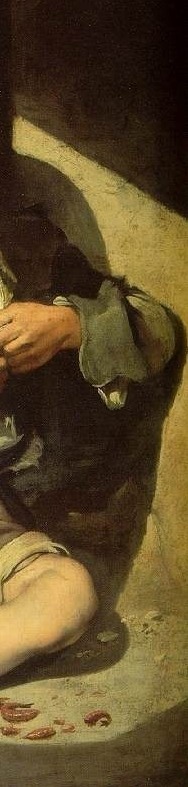

Murillo's Young Beggar is notable for the following characteristics:
Use of technique - Caravaggesque chiaroscuro:
Painted in the mid 1640s, The Young Beggar is representative of Murillo's early style, a period during which the painter was still greatly influenced by the dark tenebrism and confrontational naturalism of Caravaggio and Zurbarán.
The Young Beggar evidences a very strong contrast between the shadowy darkness of the background and the stark illumination of the young boy in the foreground. Murillo also pays careful attention to life-like, if somewhat sordid details, such as the young boy's dirty feet and patched clothes.
Still-life motifs:
Murillo may never have executed an isolated still-life, like Zurbarán, but in Young Beggar Murillo does take particular care with the depiction of the still-life elements. The clay jug, straw sac and dusty apples are all rendered with a careful, life-like precision typical of the great Spanish Baroque artists, and which derives from the Dutch and Flemish influence.
Grace and dignity:
Much like Velázquez's portraits of the royal dwarves, Murillo's Young Beggar is a huge departure from the Dutch and Flemish models from which the genre subject originates in the unusual grace and innate dignity of his figure.
In the northern models, poor, "low-life" figures were most often depicted as buffoonish, awkward, morally corrupt and perhaps even mentally challenged characters. Murillo's young urchin, on the other hand, is posed with an almost classical grace (a hallmark of this Spanish artist), a trait which points towards the sweetness and sentimentality that will come to infuse Murillo's later paintings.
The Young Beggar Related Paintings
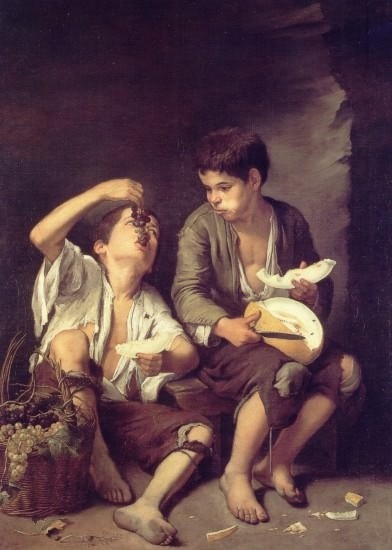
Works by Murillo:
Beggar Boys Eating Grapes and Melons, 1645
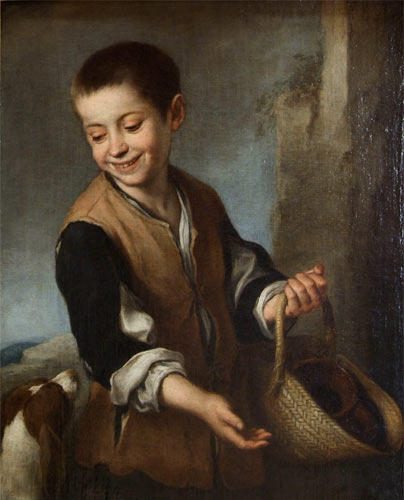
Boy with a Dog, 1655
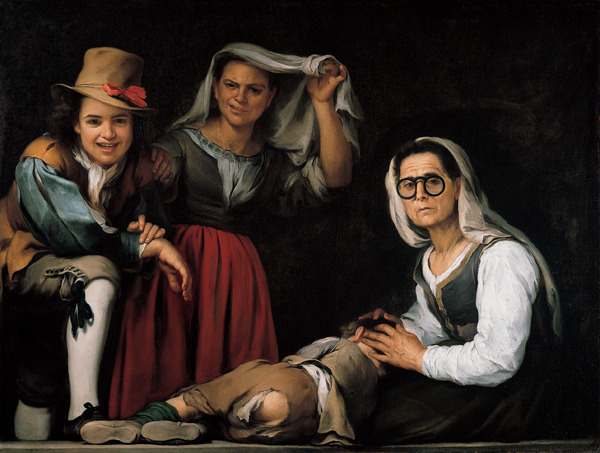
Four Figures on a Step, c. 1660
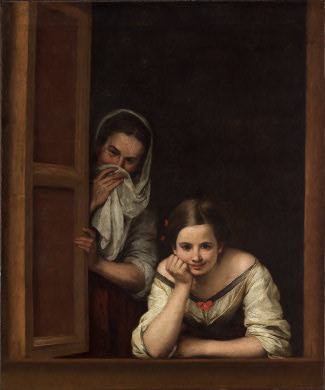
Two Women at a Window, c. 1660
Works by other artists:
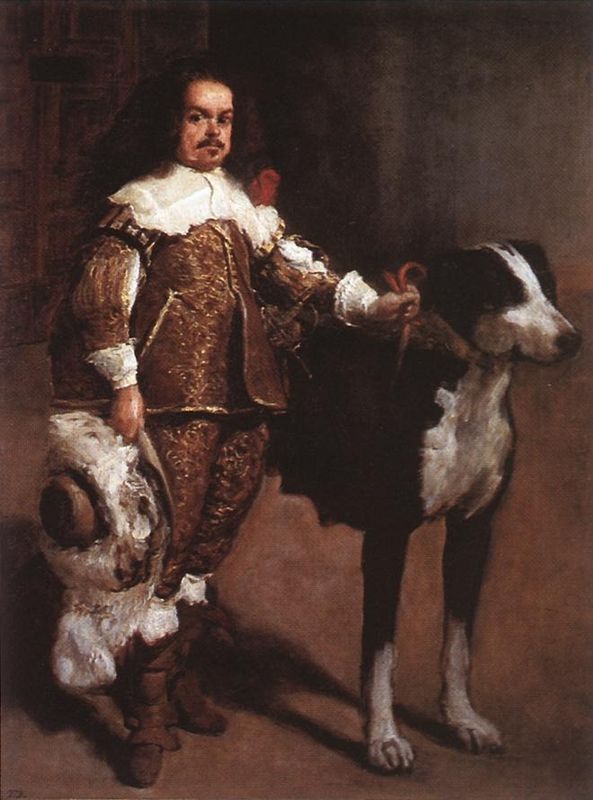
Murillo was not the first Spanish artist to depict the lives of Spain's less fortunate. Fellow (and far more famous) Sevillian painter Diego Velázquez is famous for his multitudinous paintings of the dwarves of the Spanish court, whom he depicts with an unusual humanity and dignity.
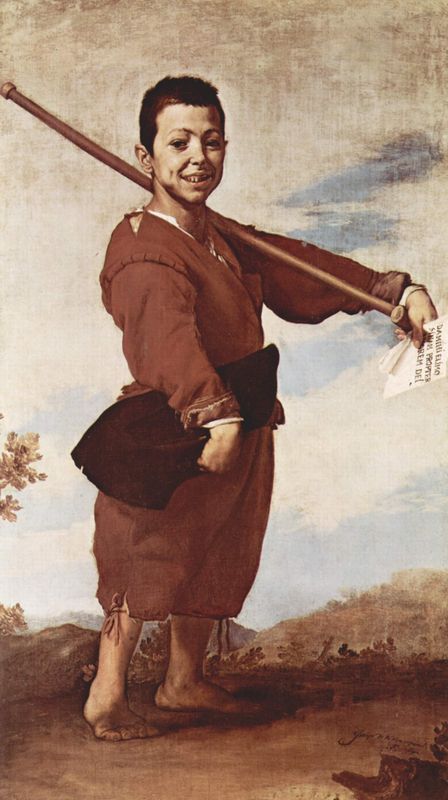
Ribera, another of the great Spanish Golden Age artists, is also well-known for his depictions of those on the margins of society, most notably with his The Clubfoot. Murillo's paintings are different, however: they don't depict the deformed, but sweet, normal children endowed with a grace and dignity ill-befitting their unfortunate circumstances.
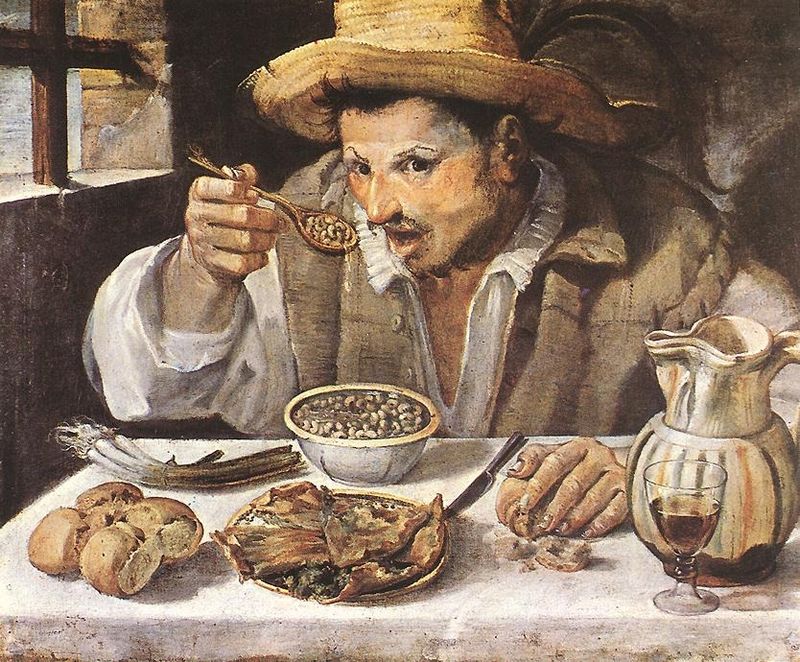
Several of Carracci's works are also examples of everyday life scenes.
The Young Beggar Artist
-
Beggar Boys Eating Grapes and Melons
-
Four Figures on a Step
Murillo's genre paintings such as The Young Beggar have garnered the artist widespread popularity, in particular his charming depictions of the street children of Seville. In fact, Murillo is perhaps most famous for his sentimental paintings of street children.
In these paintings (which were wildly popular during Murillo's lifetime and throughout the Rococo period of the 18th century), Murillo may have paid careful attention to naturalistic details in the depiction of his figures, but overall the subjects are quite idealized.
These paintings do not show the true pain and horror of orphaned children living on the streets, but instead a sweet, idealized picture of carefree kids caught in natural poses (laughing, eating, counting pennies). These pictures are often imbued with an underlying religious message.
With regards to The Young Beggar, some believe that Flemish merchants residing in Seville may have commissioned this painting by Murillo. Genre painting was popular in Flanders, and the poor featured heavily in Flemish genre painting.
Murillo's paintings were the triumph of the Spanish Baroque. Although today Velázquez is cherished as the genius of the 17th century, in his own time Murillo's paintings were far more widely known outside of Spain, and were considered so valuable that at one point the king actually forbade their export.
The sweetness and easy accessibility of Murillo's style was a welcome relief from the darkness and grave sobriety of artists like Zurbarán, and the inoffensive piety of Murillo's paintings made them perfectly suited for Counter-Reformation tastes.
The Young Beggar Art Period
Murillo was the last great painter of the Spanish Golden Age. During the 17th century, Spain saw her greatest artists and some of her greatest literature and drama in the nation's entire history; unfortunately, this century also saw Spain's worst political defeats and economic and natural disasters, including plague, earthquakes, poverty and famine.
The orphaned street urchins and impoverished characters of Murillo's genre scenes were thus the hard reality of the artist's times (although the artist's depiction of such figures has been generously sweetened and idealized). Murillo's paintings bridge the dark drama and sometimes ascetic simplicity of Spain's early Baroque artists and the fanciful sensuality of the approaching Rococo era.
In his early career, Murillo was deeply influenced by the most prominent painter in Seville at the time, Zurbarán: from the master, the younger artist learned the expressive power of chiaroscuro as well as a predilection for relatively neutral, highly compressed pictorial space.
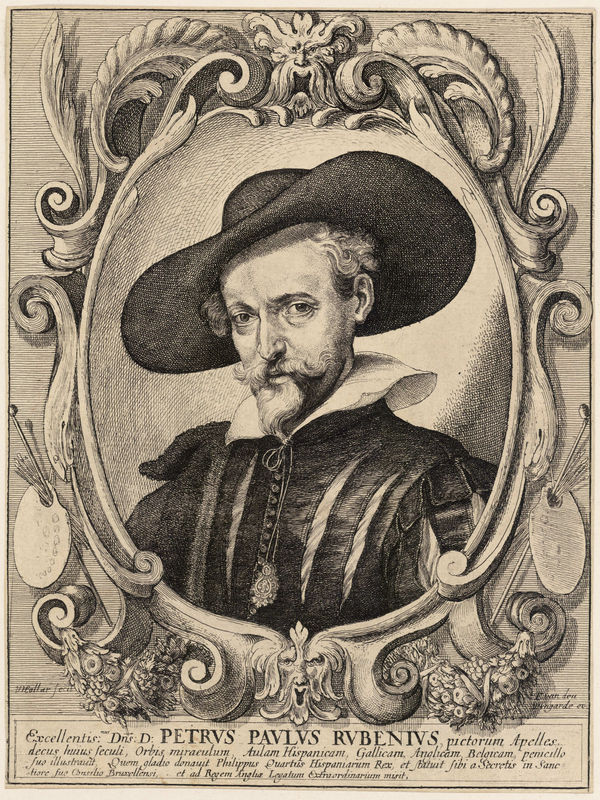
After visiting Madrid in 1658, however, Murillo discovered a new artist who would have a profound influence on the further development of his style: Peter Paul Rubens, who along with other painters represented in the Spanish royal collection showed Murillo the powerful potential of using a bright, bold palette and dynamic, expressive brushwork.
Yet, one of the most significant influences on Murillo was the pioneer of the Italian Baroque, Federico Barocci, who was completely overlooked by other Spanish painters of the Baroque era, but who was cherished by Murillo for the cheerful, sweet softness of his style.
The Young Beggar Bibliography
For further information about Murillo, please refer to the recommended reading list below.
• Bartolomé Esteban Murillo, 1617-1682. Wedenfeld and Nicolson, 1982
• Brooke, Xanthe, and Peter Cherry. Murillo. Merrell, 2001
• Brown, Jonathan. The Golden Age of Painting in Spain. Yale University Press, 1991
• Davies, E. The Life of B. Esteban Murillo: Compiled from the Writings of Various Authors. London, 1819
• Kagane, Ludmilla. Murillo: The 17th Century Spanish Master. Parkstone Press, 1997
• Keysor, Jennie Ellis. Great Artists: Raphael, Rubens, Murillo, and Dürer. Educational Publishing Company, 1899
• Mallory, Nina A. El Greco to Murillo: Spanish Painting in the Golden Age: 1556-1770. Harper Collins, 1990
• Stratton-Pruitt, Suzanne. Bartolomé Esteban Murillo, Paintings 1617-1682: Paintings from American Collections. Harry N. Abrams, 2002
• Taggard, Mindy Nancarrow. Murillo's Allegories of Salvation and Triumph: The Parable of the Prodigal Son and the Life of Jacob. University of Missouri Press, 1992